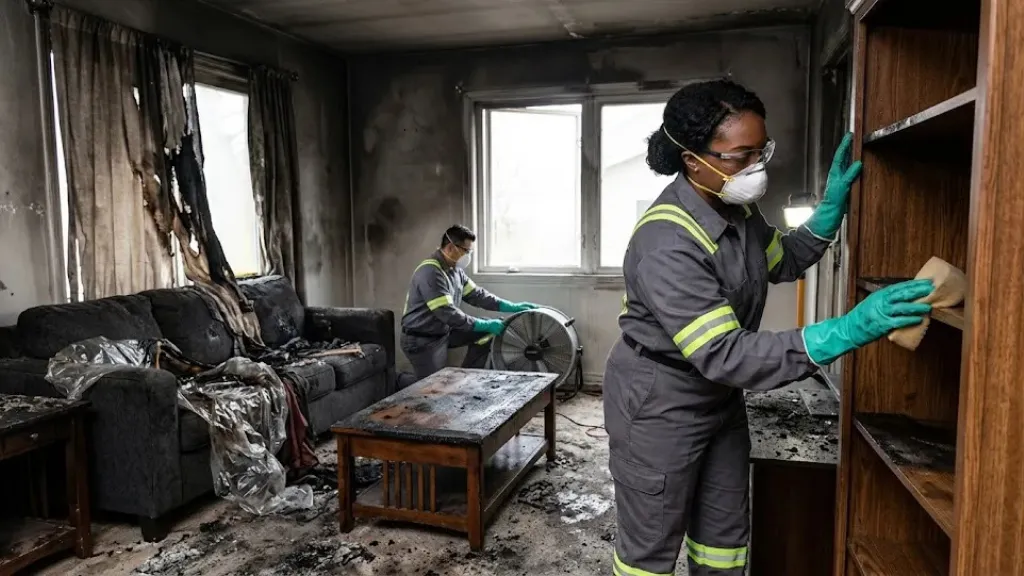
High-temperature residential and commercial fires across Will County generate aggressive chemical byproducts, aerosolized tars, and volatile organic compounds (VOCs) that instantly bond to structural substrates. As synthetic building materials, polyurethane insulation, and structural timbers combust, sub-micron carbon particles drive deep into porous drywall, timber framing, and subflooring assemblies under heavy thermal pressure. Standard household cleaning solutions fail to address these persistent smells because topical wiping only touches surface deposits while embedded gas-phase contaminants continue off-gassing into living spaces. Permanently eradicating structural smoke odors requires systematic decontamination protocols designed to oxidize odor molecules at their molecular source rather than masking them with short-acting deodorizing sprays.
Chemical Classification and Behavior of Post-Fire Residues
Smoke particulates vary significantly based on fuel type, oxygen availability, and ambient combustion temperature during a fire event. Identifying the exact residue profile across a damaged structure determines the mechanical and chemical cleaning sequence needed before gas-phase oxidation can succeed.
Fast-burning structural fires involving natural framing, hardwood paneling, and paper products under high oxygen levels produce dry carbon soot. This residue forms a loose, powdery black coating across horizontal surfaces. While dry carbon soot smudges easily if touched with liquid or wet wipes, it can be safely extracted using industrial high-efficiency particulate air (HEPA) vacuum filtration systems and vulcanized dry chemical sponges. Property owners coordinating emergency restoration in northern municipalities often rely on specialized Bolingbrook fire damage restoration services to isolate dry carbon deposits before ambient airflow spreads light dust into unburned building wings.
Smoldering low-oxygen fires fueled by modern synthetic carpet padding, vinyl flooring, plastic housing, and polyurethane furniture produce wet synthetic residues. These fires generate sticky, yellow-brown liquid tar films that chemically etch wall paints, clear coats, polished metals, and glass fixtures within 24 to 48 hours. Kitchen grease fires present a distinct chemical challenge in residential structures, where animal fats and cooking oils release vaporized lipid chains that settle evenly across cabinetry and wall cavities. Resolving these claims requires specialized Bolingbrook kitchen grease fire cleanup methods utilizing enzymatic cleaning agents to break down the lipid matrix before deep gas-phase deodorization begins.
| Residue Classification | Fuel Source Profile | Surface Behavior | Primary Remediation Method |
| Dry Carbon Soot | Framing timber, hardwood, paper, natural textiles | Fine, dry black powder; smudges if wet | HEPA vacuuming, vulcanized dry chem-sponge wiping |
| Wet Synthetic Residue | Plastics, vinyl, polyurethane foam, synthetic carpet | Sticky, smeary yellow-brown film; highly acidic | Heavy-duty alkaline degreasers, solvent washing |
| Protein Smoke Residue | Animal fats, vegetable oils, kitchen meats | Nearly invisible; pungent rancid grease smell | Enzymatic breakdown cleaners, deep thermal oxidation |
| Fuel Oil Puff-Back | Incomplete furnace or oil burner combustion | Dense, greasy aerosolized soot coating entire home | Lipophilic solvent washing, complete HVAC scrubbing |
Local Building Structures, Stack Effect, and Environmental Micro-Climates
Structural layouts, HVAC configurations, and regional weather patterns across Will County directly influence smoke particle movement and odor retention. The region features a blend of historic multi-story homes, modern suburban subdivisions, and light industrial facilities across expansive prairie terrain.
During cold Midwest winter months, structural stack effect acts as a primary driver of vertical smoke migration. As interior heating systems warm ambient air inside a structure, the warm air rises naturally toward upper floors and vented attic spaces, creating a low-pressure zone at ground and basement levels. This pressure gradient pulls aerosolized soot, toxic gases, and fine ash upward through open stairwells, electrical chases, plumbing penetrations, and wall framing voids. Consequently, heavy soot accumulation and intense odor off-gassing frequently concentrate in upper-floor ceiling joists and attic insulation even when a fire originated in a lower-level utility room or basement workshop.
- Lower Level / Ignition Origin: High-heat combustion generates concentrated gas-phase pollutants and thermal convection currents.
- Main & Upper Living Levels: Convective air currents pull rising warm air and high VOC concentrations through vertical stairwells and utility chases, embedding soot into drywall and subflooring.
- Attic Space & Roof Decking: Thermal stack forces push airborne soot upward, depositing the highest particle density into blown-in cellulose and fiberglass insulation.
High summer humidity creates opposite challenges for structural odor removal. Unconditioned attic spaces, porous subfloors, and unsealed masonry walls absorb atmospheric moisture during humid weather, causing wood cells and gypsum wallboard to expand. This cellular expansion traps volatile organic compounds deeper within building substrates. As temperatures fluctuate throughout the season, these trapped compounds continually leach back into living areas, causing smoke smells to return if structural framing was not thoroughly decontaminated and sealed.
To ensure structural restoration aligns with regional safety guidelines, environmental standards, and municipal building code requirements, property owners can review official guidance through the Will County Land Use Department.
Technical Neutralization and Odor Removal Protocols
Eradicating stubborn smoke odors requires a multi-stage technical remediation process designed to remove physical surface residues before neutralizing gas-phase compounds. Simply masking odors with scented sprays or topical sealers traps active VOCs beneath surface films, leading to eventual coating failure and persistent off-gassing.
1. Containment and HEPA Air Scrubbing
Before initiating chemical cleaning or air treatment, technicians isolate contaminated areas using 6-mil flame-retardant polyethylene barriers and negative air pressure differentials. Industrial air scrubbers equipped with three-stage filtration, a primary pre-filter, a secondary pleated filter, and a high-capacity activated carbon cell, run continuously. This arrangement extracts airborne carbon particles and gas-phase VOCs while preventing cross-contamination into unburned building zones.
2. Precision Surface Decontamination
Gas-phase oxidation equipment must always operate on clean structural substrates. Applying thermal fogging or ozone over heavy soot deposits traps volatile organic compounds under carbon layers, reducing treatment efficiency.
- Dry Removal Methods: High-power HEPA vacuums sweep loose soot off exposed ceiling joists, wall studs, and brick chimneys. Dry vulcanized rubber sponges lift carbon soot from painted drywall surfaces without moisture, preventing liquid from dissolving pigments deeper into the wallboard paper.
- Wet Solvent Washing: Synthetic smoke films require heavy-duty alkaline degreasers combined with specialized lipophilic solvents. Technicians wash vertical surfaces from top to bottom, replacing washing solutions frequently to prevent smearing dissolved tars onto clean substrates.
3. Thermal Fogging and Micro-Droplet Penetration
Thermal fogging equipment heats petroleum- or water-based deodorizing solutions, generating a dense dry mist with particle sizes ranging between 0.5 and 2 microns. These microscopic droplets match the exact physical dimension of natural combustion smoke particles. The fog follows identical thermal expansion pathways through structural cracks, subflooring gaps, and wall voids, binding directly with embedded VOC molecules to alter their chemical composition and eliminate odor output.
4. Hydroxyl and Ozone Gas Oxidation
Advanced gas-phase oxidation technologies break down complex hydrocarbon chains embedded within porous building materials:
- Hydroxyl Generators: Utilizing specific ultraviolet light wavelengths and ambient humidity, hydroxyl optics generate reactive hydroxyl radicals. These radicals actively neutralize complex organic compounds, sulfur gases, and smoke molecules. Hydroxyl processing is safe for occupied spaces and does not degrade interior vinyls, sensitive electronics, or natural rubber items.
- Ozone Generators: Ozone (O3) provides rapid oxidation by breaking apart carbon bonds in volatile organic compounds. Because elevated ozone concentrations are toxic to human lung tissue and pets, ozone treatments require complete building evacuation and strict containment protocols.
5. HVAC System Cleaning and Duct Encapsulation
Forced-air HVAC systems rapidly distribute smoke particles throughout a structure during a fire. Blower fans pull aerosolized soot into return air ducts, coating main trunk lines, branch vents, and cooling coils with acidic films. Complete HVAC restoration requires mechanical agitation using pneumatic whip lines combined with continuous high-volume negative air vacuuming. Once cleaned, internal duct walls are fogged with an EPA-registered anti-microbial encapsulant to lock down residual micro-particles and prevent future odor emissions.
Essential Property Owner Hazard Protocol
Executing safe, effective post-fire recovery requires strict adherence to safety protocols during initial property walkthroughs.
- Confirm Structural Stability: Never enter a fire-damaged structure until local fire officials or licensed structural engineers confirm that load-bearing wall studs, floor joists, and roof decking are structurally sound.
- Utilize Respiratory Protection: Always wear an N95 or P100 rated respirator, heavy nitrile gloves, and eye protection when entering soot-impacted zones to avoid inhaling microscopic carbon particulates and toxic synthetic ash.
- Isolate Electrical Power: Keep main breaker switches OFF if soot accumulation covers electrical outlets, breaker panels, or overhead light fixtures. Energizing compromised circuits risks short circuits or secondary fires.
- Avoid Improper Water-Based Cleaning: Do not scrub dry carbon soot with household water-based detergents. Applying water to dry carbon smudges acidic pigments deep into painted finishes and porous drywall, significantly increasing overall restoration costs.
- Keep Air Handling Systems Switched Off: Leave central heating and air conditioning units turned OFF until air ducts, blower compartments, and filter housings undergo complete inspection and cleaning. Running contaminated HVAC equipment blows acidic soot into unburned rooms.
Taking organized, prompt steps prevents secondary structural damage and controls overall repair costs. For properties suffering deep smoke penetration across suburban residential sectors, securing dedicated smoke odor removal in Bolingbrook, IL ensures trained specialists deploy industrial air scrubbers, thermal foggers, and molecular oxidation units effectively.
Systematic decontamination halts ongoing acidic etching on fixtures, restores healthy indoor air quality, and protects long-term structural integrity. Accessing prompt assistance through an established emergency fire damage restoration network connects property owners with independent local specialists equipped to handle complex fire recovery challenges safely.